


『Dryer Vent Air Flow Meter: Troubleshooting Residential HVAC Ventilation Efficiency』Related information(v cone flow meter|rotary gas meter|gallon meter|gear meter|metal tube rotameter|glass tube rotameter|nutating disk meter|transit time ultrasonic flow meter|wedge flow meter|pd meters|hydraulic flow meter|ultrasonic water flow meter|water flow meter|air flow meter|magnetic water flow meter|oxygen flow meter|gas flow meter|argon flow meter|air velocity meter|gasoline flow meter|fuel flow meter|ultrasonic water meter|digital water meter|nitrogen flow meter|solid flow meter|Oxygen tank flow meter|digital water flow meter|diesel fuel flow meter|steam flow meter|02 flow meter|compressed air flow meter|oil flow meter|liquid flow meter)

Dryer Vent Air Flow Meter: Troubleshooting Residential HVAC Ventilation Efficiency
Quick Answer: A dryer vent air flow meter helps you measure duct airflow before you replace parts. Low flow often comes from lint buildup, long flexible duct runs, or a failed booster fan. Silver Instruments supplies thermal mass flow meters and differential pressure transmitters for HVAC airflow testing.
Most industrial flow meter suppliers ignore residential dryer vents. But facility teams in Australia, Southeast Asia, and the Middle East ask us about this problem often. They manage apartment buildings, university housing, or commercial laundry rooms. The same issue appears again and again. Lint restricts the duct. The booster fan fails. The flexible duct sags. A hand test at the vent outlet is not enough. You need a repeatable airflow number.
Why Dryer Vent Airflow Drops
Most residential dryers push 100 to 200 CFM through a 4 inch duct. The hot exhaust carries lint, moisture, and heat. Lint builds up on the duct wall. A 4 inch duct with 0.25 inch of lint can reduce flow by 30 to 50 percent. Long runs make the problem worse. Each elbow adds 5 feet of equivalent length. Many dryer manufacturers allow a maximum of 25 feet equivalent. Installations often exceed this. Booster fans rated 120 CFM cannot always overcome sagging flexible duct. Moisture condenses inside. Lint sticks faster. The dryer then runs longer and trips the thermal overload. This pattern is common in multi unit housing.
How to Measure Airflow Correctly
Do not rely on a tissue test. The tissue only shows that some air exits the vent. It does not give velocity, volume, or pressure. Use a thermal mass flow meter or a differential pressure transmitter instead. Insert the thermal probe into the duct. Log values for 10 minutes. A healthy dryer vent shows 80 to 200 CFM depending on the dryer model. Readings below 60 CFM point to a restriction. You can also install a differential pressure transmitter across the duct. A pressure drop above 0.2 inH2O usually indicates lint blockage. Silver Instruments supplies insertion and inline thermal mass flow meters with 4-20 mA HART output. They measure air velocity from 0.5 m/s to 100 m/s. They work on 24 VDC and use PT100 sensors for temperature compensation. Wire the output to a PLC or data logger.
Here is the thing. Most technicians skip the measurement. They replace the dryer or the booster fan first. Then the new unit trips again. The measurement costs less than one service call in most cases. We have seen this on customer sites many times.
Troubleshooting Steps
Start at the dryer. Remove the transition duct from the wall. Inspect the first 3 feet. This area collects the most lint because the air is hottest and most turbulent. Clean it with a vacuum and a flexible brush.
Check the duct length and routing. Count the elbows. If the equivalent length exceeds 25 feet, you likely need a booster fan. But before adding a fan, measure the existing airflow. A fan added to a blocked duct just pushes moisture deeper into the wall. In practice, cleaning solves most airflow complaints. A commercial laundry in Bangkok had one d
Inspect the outside vent cap. A louver with a 1/4 inch mesh screen can trap lint. Birds and rodents can also build nests inside. Remove the screen or replace the cap. Check the backdraft damper. It should open fully at 0.1 inH2O. A stiff damper spring creates backpressure. A differential pressure transmitter shows this clearly.
Using a Thermal Mass Flow Meter
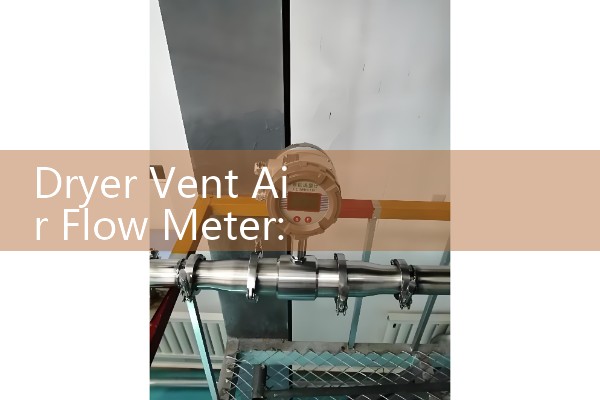
A thermal mass flow meter measures mass flow directly. You do not need separate pressure and temperature compensation. For dryer vent testing, a portable unit with a 12 mm insertion probe works well. Drill a test port into the 4 inch duct. Insert the probe and seal the port after the test. The meter displays m3/h or CFM. This gives you a repeatable number. It lets you compare before and after cleaning. It also documents the result for the building owner. Silver Instruments offers thermal mass flow meters with RS485 Modbus and pulse output. For fixed installation in central laundry exhaust systems, use an inline meter sized to the duct. Tell us your duct ID in mm, your normal flow in m3/h, and your required output signal. We will recommend the right meter body and probe length.
Residential HVAC is not a chemical plant. But the measurement principle is the same. Velocity times cross sectional area equals volume flow. If the duct area is fixed, velocity gives you a reliable number. You can also use a pitot tube with a differential pressure transmitter. The pitot tube costs less but is more sensitive to dust and lint. The thermal probe handles dirty exhaust better.
FAQ
Q: What is a normal dryer vent airflow in CFM?
A: Most dryers move 100 to 200 CFM through a 4 inch duct. Below 60 CFM usually means lint buildup or a crushed duct.
Q: Can you use a thermal mass flow meter in a dusty duct?
A: Yes. The insertion probe tolerates moderate lint. Clean the probe after each test. For very heavy lint, use a differential pressure transmitter with purge air.
Q: What is the maximum dryer vent duct length?
A: Many dryers allow 25 feet equivalent length. Each 90 degree elbow adds 5 feet. Exceeding this often requires a booster fan and a flow meter to verify performance.
Q: Which Silver Instruments meter works for HVAC airflow testing?
A: For portable testing use an insertion thermal mass flow meter with 4-20 mA HART. For fixed monitoring use an inline meter from DN15 to DN200. Provide your duct size and flow range for a quote.
Q: How often should you check dryer vent airflow?
A: In multi unit housing, check every 6 months. In commercial laundry rooms, check every 3 months. Document before and after cleaning.
Send your duct diameter in mm, your airflow range in m3/h or CFM, and your pressure drop in Pa or inH2O. We will recommend a flow meter with the correct probe length and output. Contact Silver Instruments. Tel: +86-25-68650347. Whatsapp: +86-25-52155837. WeChat: +86 15365082610.
 Hot Blog
 Related AD