

『Magnetic Flow Meter Installation Checklist: Straight Pipe Runs and Flow Direction』Related information(v cone flow meter|rotary gas meter|gallon meter|gear meter|metal tube rotameter|glass tube rotameter|nutating disk meter|transit time ultrasonic flow meter|wedge flow meter|pd meters|hydraulic flow meter|ultrasonic water flow meter|water flow meter|air flow meter|magnetic water flow meter|oxygen flow meter|gas flow meter|argon flow meter|air velocity meter|gasoline flow meter|fuel flow meter|ultrasonic water meter|digital water meter|nitrogen flow meter|solid flow meter|Oxygen tank flow meter|digital water flow meter|diesel fuel flow meter|steam flow meter|02 flow meter|compressed air flow meter|oil flow meter|liquid flow meter)

Magnetic Flow Meter Installation Checklist: Straight Pipe Runs and Flow Direction
Quick Answer: Magnetic flow meters need a fully developed flow profile to deliver the rated accuracy of 0.5 % or 0.2 %. You normally need at least 5 pipe diameters (DN) of straight pipe upstream and 3 DN downstream. Always install the meter so the arrow on the sensor body matches the real process flow direction.
Why Straight Pipe Runs Are Not Optional
An electromagnetic flow meter reads voltage generated by a conductive liquid moving through a magnetic field. That tiny voltage signal assumes a symmetrical velocity profile across the pipe cross‑section. A single elbow, a partially open gate valve, or a pump discharge right before the meter distorts the profile into a swirl or a jet. The meter then averages a wrong velocity and reports a flow rate that can be 5 % to 15 % off. In practice, you never want to explain a 10 % billing error to a water utility in Australia or a chemical buyer in Saudi Arabia just because you saved 200 mm of pipe.
Here is the thing. Most engineers skip the required straight run when a pump skid is tight. We have seen this on customer sites many times. A dairy plant in New Zealand put a DN50 magmeter right after a reducing elbow. The meter read 30 % high during CIP cycles because the liquid hugged one electrode. We fixed it with a flow straightener and a short spool piece. The reading dropped into specification on the next batch.
Recommended Upstream and Downstream Distances
Silver Automation Instruments follows the test data behind ISO 9104 and factory wet‑calibration reports. The table we share with every installer is simple. After a single 90° elbow, keep 10 DN straight upstream. After a pump or a control valve, keep 20 DN upstream. After two elbows in different planes, keep 25 DN upstream. The downstream requirement is easier. Keep 5 DN after the meter before any valve, tee, or orifice. These numbers are for a full‑bore magmeter with an internal diameter that matches the pipe schedule. For a DN300 raw water line feeding a desalination plant in Oman, that means you need at least 3 metres of straight pipe before the meter flange and 1.5 metres after it.
Some compact magmeters with a conical flow tube design can work with shorter upstream runs. But do not assume this works for viscous fluids above 100 cP. A corn syrup line in Thailand taught us that lesson. The meter needed a full 15 DN upstream because the Reynolds number was very low even at 2 m/s. When in doubt, send us your fluid viscosity (cP), conductivity (µS/cm), and pipe layout. We check the velocity profile correction before you order.
Flow Direction Arrow and Electrode Positioning
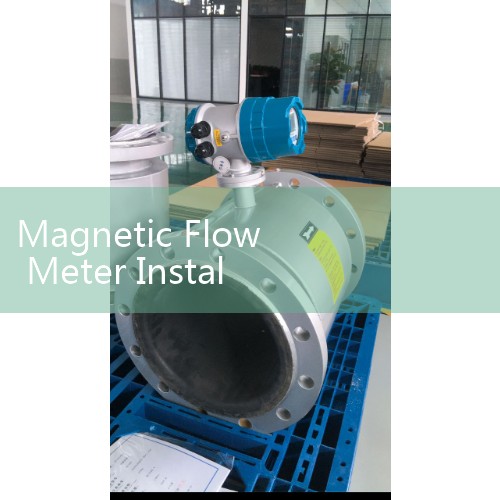
Every Silver Instruments magmeter has a flow direction arrow cast into the sensor body or printed on the stainless steel tag. Install the meter so the arrow points the same way the liquid moves under normal operation. If you reverse the body, the meter will still give a flow reading. The signal polarity simply flips. Many transmitters let you set a reverse flow detection mode via the 4‑20 mA HART output. But the factory calibration was done with forward flow. A backwards installation adds an avoidable bias, especially in custody transfer applications where every 0.1 % matters.
Electrode orientation matters just as much. In horizontal pipes, the electrodes must sit in the 3 o’clock and 9 o’clock positions. This keeps them always wetted and prevents air bubbles or sediment from insulating the signal. A paint manufacturer in Southeast Asia mounted a DN80 magmeter with electrodes at 12 o’clock and 6 o’clock. Titanium electrodes at the top trapped air and the meter went to zero every few minutes. Rotating the spool piece 90 degrees solved it. In vertical pipes with upward flow the orientation is less critical, but you still need to guarantee a full pipe at all times.
Common Job‑Site Mistakes We See From Lagos to Lima
One mistake is reading the straight pipe requirement from a generic datasheet and applying it to a p
_600x400.jpg)
Another frequent error is ignoring grounding rings in non‑conductive pipe sections. A lined steel pipe or a plastic pipe breaks the electrical ground reference. Without a proper ground, the 4‑20 mA output jumps with every VFD start nearby. For an ATEX Zone 1 installation on a methanol line in a Nigerian chemical plant, we supplied titanium grounding rings and a dedicated ground strap. The loop stability improved immediately.
Last year a customer in Vietnam asked us why his DN150 wastewater meter read 15 percent low. He had a gate valve just 2 DN upstream. The valve gate was partly open and deflected the flow jet toward one electrode. We added a spool piece to reach 10 DN and the accuracy came back to within 0.4 % on the next verification run with a portable ultrasonic clamp‑on reference.
How Silver Automation Instruments Supports Your Installation
We do more than ship a box. Our application engineers review your P&ID or a simple sketch before quoting. We check the straight run, the pipe schedule, the lining material compatibility with your CIP media, and the required ingress protection. If a standard straight run is impossible, we can recommend a flow conditioning plate tested on a DN100 magmeter loop. These plates reduce the needed upstream distance from 10 DN down to 3 DN while keeping the accuracy within 0.5 %. This works for clean water, treated wastewater, and many food‑grade liquids.
For seawater intake lines in the Middle East, we often pair a Silver Instruments electromagnetic flow meter with a PT100 temperature sensor and a local display. The straight run rule still applies even with a fully welded spool piece. We have shipped pre‑assembled meter runs with flanged straight pipes and grounding rings ready to bolt into a GRP line. That saves the contractor field welding and alignment time.
Frequently Asked Questions
What is the minimum straight pipe for a magnetic flow meter?
Minimum is typically 5 DN upstream and 3 DN downstream for a standard full‑bore meter with no flow disturbances. After an elbow or a valve, increase the upstream to 10 DN or 20 DN. Check the specific ISO 9104 recommendation for your fitting type.
Can I install a magmeter in a vertical pipe?
Yes. Vertical installation with upward flow is often preferred because it helps keep the pipe full. You must still meet the straight run requirement. Mount the meter at a low point in the line to maintain back pressure.
What happens if I install the meter backwards?
The meter will output a negative flow value if the transmitter allows it. Accuracy is still good but the factory forward‑flow calibration gets a small offset. Swap the installation or simply reverse the current output scaling in the converter. It is better to follow the arrow.
Do I always need grounding rings?
Not on conductive unlined metal pipes that are electrically bonded. On lined steel, plastic, or GRP pipes you need grounding rings, a grounding electrode, or a virtual ground circuit. We include grounding rings in your quote if you tell us the pipe material.
How can I reduce the required straight run?
Use a flow straightener certified for magnetic flow meters. A properly designed plate can cut the upstream need from 10 DN to 3 DN. Silver Automation Instruments tests its straighteners on a DN100 test rig with water and a 10‑point velocity traverse. Ask for a test report specific to your DN.
Get a quotation with the right straight run for your pipe size. Send us your pressure (bar), temperature (°C), pipe size (DN), and flow range. Email [email protected] or call +86-135-1213-1526. WhatsApp 86-135-12131526 is open for sketches and installation photos. Silver Automation Instruments replies within one business day.
 Hot Product
 Related AD