

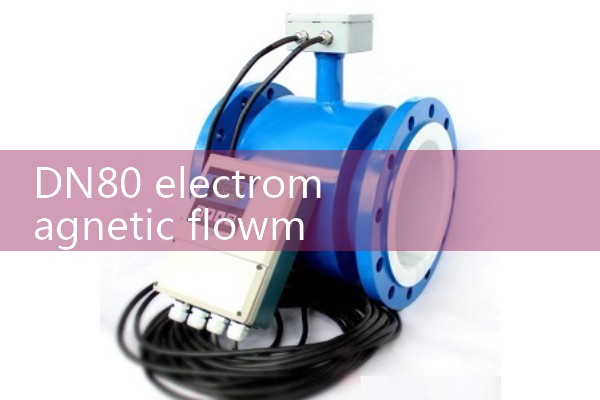
『DN80 electromagnetic flowmeter』Related information(v cone flow meter|rotary gas meter|gallon meter|gear meter|metal tube rotameter|glass tube rotameter|nutating disk meter|transit time ultrasonic flow meter|wedge flow meter|pd meters|hydraulic flow meter|ultrasonic water flow meter|water flow meter|air flow meter|magnetic water flow meter|oxygen flow meter|gas flow meter|argon flow meter|air velocity meter|gasoline flow meter|fuel flow meter|ultrasonic water meter|digital water meter|nitrogen flow meter|solid flow meter|Oxygen tank flow meter|digital water flow meter|diesel fuel flow meter|steam flow meter|02 flow meter|compressed air flow meter|oil flow meter|liquid flow meter)
1. Calculation method of electromagnetic flowmeter caliber
The calculation of electromagnetic flowmeter caliber needs to first determine the theoretical caliber based on the flow demand and flow rate range, and then comprehensively select it based on actual factors such as accuracy and cost. The specific steps are as follows
1. Calculate the flow demand. Determine the fluid volume that needs to be measured per unit time based on the actual working conditions, that is, the volume flow rate (Q), usually in m3/h or L/s. Example: If 500m3 of water needs to be drained within 4 hours, the flow rate is: $$Q=frac {500, text {m}3 }{4, text{h}} = 125, text {m}3 /Text {h} $2. Determine the flow velocity range. The electromagnetic flowmeter requires a fluid flow velocity of not less than 0.5m/s (to avoid sedimentation or measurement errors), a normal range of 2-4m/s (with the best accuracy and stability), and a maximum of 8m/s (to prevent cavitation or wear). Priority should be given to selecting 2-4m/s to balance measurement accuracy and equipment lifespan. Calculate the theoretical diameter based on the flow formula Q=A cdot v=pi r ^ 2 cdot v (A is the cross-sectional area of the pipeline, v is the flow velocity), and derive the calculation process for the diameter D=2r: unify the flow unit as m3/s: $125, text {m}3 /text{h} = frac{125}{3600}, text {m}3 /text{s} approx 0.0347, text {m}3 /Calculate the pipeline radius (r) based on the flow velocity range: when the minimum flow velocity is 0.5m/s:$$ r = sqrt{frac{Q}{pi v}} = sqrt{frac{0.0347}{3.14 times 0.5}} approx 0.149, text{m}$$ Corresponding caliber $$D=2r approximate 0.298, text {m} $$(i.e. DN300). When the maximum flow velocity is 8m/s: $$r=sqrt {frac {0.0347}
5. Considering practical factors, the caliber accuracy requirement is selected. When the flow velocity is close to 2-4m/s, the measurement error is minimized, and the caliber within this range is preferred. Cost and installation: The larger the diameter, the higher the equipment cost, installation space, and maintenance cost. Fluid characteristics: If the fluid contains solid particles or is prone to sedimentation, the flow rate can be appropriately increased (choose a smaller diameter) to prevent blockage. Example Decision: DN100 was ultimately chosen in the question because it balances cost and accuracy while meeting flow requirements (flow rate of approximately 4m/s, close to the upper limit of the optimal range)
6. Validation and Adjustment: Based on the selected diameter and flow rate, the actual flow rate is calculated to meet the requirements: The flow rate of DN100 pipeline (inner diameter 0.1m) at 4m/s flow rate is: $$Q=pi (0.05) ^ 2 times 4 times 3600 approximate 113, text {m}3 /Text {h} $$is slightly lowe
 Hot Blog
 Related AD