

 Current position > Product detail
『DN250 Vortex Flow Meter』Related information(v cone flow meter|rotary gas meter|gallon meter|gear meter|metal tube rotameter|glass tube rotameter|nutating disk meter|transit time ultrasonic flow meter|wedge flow meter|pd meters|hydraulic flow meter|ultrasonic water flow meter|water flow meter|air flow meter|magnetic water flow meter|oxygen flow meter|gas flow meter|argon flow meter|air velocity meter|gasoline flow meter|fuel flow meter|ultrasonic water meter|digital water meter|nitrogen flow meter|solid flow meter|Oxygen tank flow meter|digital water flow meter|diesel fuel flow meter|steam flow meter|02 flow meter|compressed air flow meter|oil flow meter|liquid flow meter)
What are the sizes corresponding to different diameters of vortex flowmeters?
Vortex flowmeters of different diameters correspond to different sizes, and products produced by different manufacturers may have differences in specific dimensions. Taking the common DN25 caliber as an example, its length is generally around 150mm and the outer diameter is about 32mm. The DN50 caliber vortex flow meter has a length of about 200mm and an outer diameter of about 57mm. For DN80 caliber, the length is usually around 250mm and the outer diameter is about 89mm. For DN100 caliber, the length is about 300mm and the outer diameter is about 108mm. When the caliber increases to DN150, the length is approximately 400mm and the outer diameter is about 159mm. The length of a DN200 caliber vortex flowmeter is generally around 500mm and the outer diameter is about 219mm. These dimensional data are only approximate ranges. In practical applications, when selecting a vortex flowmeter, accurate dimensional information should be obtained based on the product manual and specification parameter table provided by the specific manufacturer to ensure correct installation and use.
2. For DN250 pipelines, the size of the flow meter to be installed depends mainly on your flow rate. Flow meters have specification parameters, whether it is glass rotors, metal floats, vortex streets, electromagnetic flow meters, etc. The main data of the instrument design is mainly determined by flow rate, medium characteristics (such as liquid, gas, corrosiveness, conductivity, etc.), temperature, pressure, installation method, working conditions, economic conditions, and other comprehensive factors. The selection of flow meters is a science, so it is n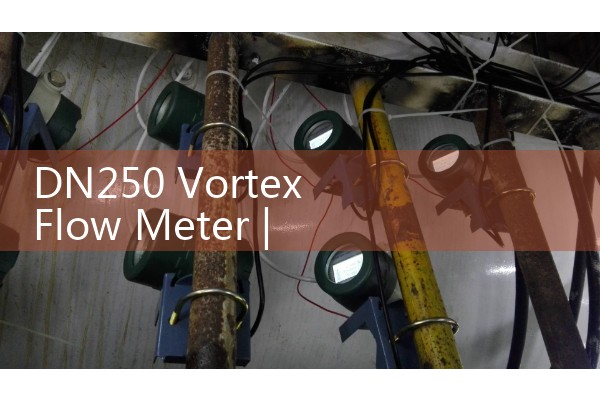
3. The difference between turbine flowmeter and vortex flowmeter should be explained in detail and comprehensively.
KNKE, a well-known American imported flowmeter brand with good customer reputation and fast delivery time, answers your question.
1. Differences in application fields: Vortex flowmeter slag: mainly used for flow measurement of industrial pipeline media fluids, such as gas, liquid, vapor and other media.
. Its characteristics are small pressure loss, large range, high accuracy, and almost unaffected by parameters such as fluid density, pressure, temperature, viscosity, etc. when measuring volumetric flow rate under working conditions. Without any movable mechanical parts, the macro beam has high reliability and low maintenance. The instrument parameters can be stable for a long time. Turbine flowmeter: widely used for measuring objects such as petroleum, organic liquids, inorganic liquids, liquefied gas, natural gas, coal gas, and low-temperature fluids. It has a simple structure, few processed parts, light weight, easy maintenance, high flow capacity (the same caliber can pass through a large flow rate), and can adapt to high parameters (high temperature, high pressure, and low temperature). 2. Differences in Production and Manufacturing: A turbine flowmeter is an instrument that uses a multi blade rotor (turbine) to measure the average flow rate of a fluid and cal