

 Current position > Product detail
『Selecting a Commercial Pool Pump Flow Meter for Optimal Water Turnover』Related information(v cone flow meter|rotary gas meter|gallon meter|gear meter|metal tube rotameter|glass tube rotameter|nutating disk meter|transit time ultrasonic flow meter|wedge flow meter|pd meters|hydraulic flow meter|ultrasonic water flow meter|water flow meter|air flow meter|magnetic water flow meter|oxygen flow meter|gas flow meter|argon flow meter|air velocity meter|gasoline flow meter|fuel flow meter|ultrasonic water meter|digital water meter|nitrogen flow meter|solid flow meter|Oxygen tank flow meter|digital water flow meter|diesel fuel flow meter|steam flow meter|02 flow meter|compressed air flow meter|oil flow meter|liquid flow meter)
Selecting a Commercial Pool Pump Flow Meter for Optimal Water Turnover
Quick Answer: For commercial swimming pools, the most reliable flow meter is a full-bore electromagnetic flow meter with 316L electrodes and PTFE lining. It handles chlorinated water, has no moving parts, and outputs 4-20 mA HART directly to your control panel. Choose a meter with a flow range covering 0.5 to 10 m/s and confirm conductivity above 20 µS/cm. If you size it right on the pump discharge line, you will maintain the required turnover rate without guesswork.
Most pools in hotels, water parks, and public recreation centres run on strict health codes. A typical 50-metre competition pool holds 2.5 megalitres and needs a turnover of 4 to 6 hours. That means moving roughly 400 to 600 m³/h. The pump might be rated for that, but without a flow meter on the discharge pipe you are only reading a curve. After a few months of filter loading and pipe scaling, actual flow drops. We have measured 15 to 20 percent lower flow on suction-side dirty strainers in a resort in Bali last year, just because the maintenance team had no real-time reading.
Why Flow Measurement Matters for Commercial Pools
Flow rate directly affects chemical dosing and filtration efficiency. In a public pool in Singapore, the National Environment Agency requires turnover rates to be documented. Operators log flow once per day from a manual gauge. That is not enough. A flow meter with a 4-20 mA output feeding into a building management system gives you continuous data. You spot a blocked strainer in minutes, not days.
Also, when you backwash sand filters, you need a high flow velocity. Too low and the media does not lift properly. Too high and you lose filter media. A flow meter on the backwash line tells you exactly what velocity you have inside the tank. In practice, most operators skip this part and rely on pump runtime. But a client we worked with in Phuket saved 11 percent on their annual chemical bill just by adjusting chlorine dosing based on actual flow, not assumed flow.
Key Parameters to Specify
Pipe size on commercial pool pump headers is often DN100, DN150, or DN200. Make sure you order a meter in the same nominal diameter. Unlike water utility pipes, pool pipes are typically uPVC or stainless steel 316. For an electromagnetic flow meter, the liner should be PTFE or hard rubber. Electrodes in 316L handle free chlorine levels up to 3 mg/L without issue. If you use ozone or salt chlorinators, still stick with 316L and PTFE. Hastelloy C electrodes are overkill here.
Flow range matters. A DN100 meter with a typical velocity of 0.5 to 5 m/s covers about 14 to 140 m³/h. If your pump does 80 m³/h on one circulation loop, a DN100 meter will sit in the sweet spot. Tell us your pump curve and pipe ID. We can suggest the right meter size so you get a stable reading even when the variable speed drive ramps down to 30 Hz. Do not buy a meter sized for maximum fire flow when you only need pool circulation.
Temperature and pressure inside the pipe are usually benign: 10 to 40 °C and 2 to 4 bar. Standard IP67 or IP68 compact-type magmeters work fine. If the pump room floods occasionally, go for IP68 and the sensor can stay submerged for days.
Flow Meter Technologies That Work
Electromagnetic flow meters are the standard choice. The pool water is conductive enough due to dissolved salts and chlorine. Even freshwater pools with TDS around 300 mg/L give sufficient conductivity. Ultrasonic clamp-on meters do not work well on uPVC walls because the pipe material dampens the signal. Mechanical meters like turbine or paddlewheel get jammed by hair, lint, and calcium scale. We pulled a paddlewheel meter from a resort pool pump room in the Maldives after only five months. The rotor was coated with calcium deposits and read 40 percent below actual flow.
Coriolis mass flow meters are too expensive for this application. They make sense in chemical dosing lines for sodium hypochlorite or hydrochloric acid. But for bulk water circulation, an electromagnetic flow meter with a local display and 4-20 mA output is the practical choice. Some brands now offer Bluetooth or NFC for setup from a phone, but on a crowded equipment pad, a wired signal to the PLC is what engineers trust.
Installation on the Pump Discharge Line
Install the meter downstream of the pump
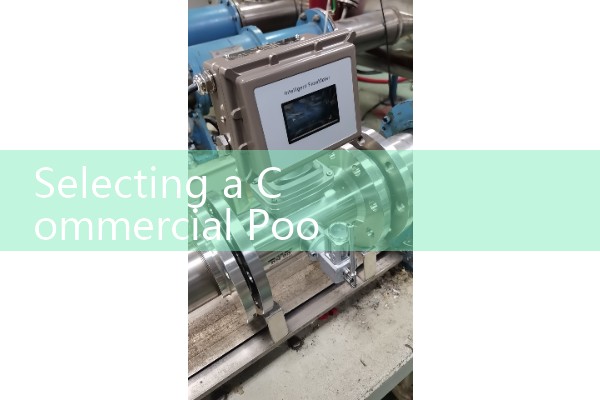
Grounding is important. uPVC is an insulator. You need grounding rings or an integral ground electrode. Silver Instruments offers a version with a built-in third electrode for grounding, so you do not need separate rings. For stainless steel pipes, simple strap grounding works.
Real-World Feedback from Pool Operators
Here is the thing. You might order a meter with Modbus RTU, but the pump service company only speaks 4-20 mA. We have seen this on customer sites many times. A simple 4-20 mA output scaled 0 to 100 m³/h can be read by any PLC, chemical controller, or data logger. You avoid protocol headaches. Later, if you upgrade to a full SCADA, you can add a HART modem to pull diagnostic data without rewiring.
Last year a customer in Vietnam asked us for a battery-powered magnetic flow meter with wireless transmission. Their pool equipment pad was 200 metres from the control room and pulling cables was too costly. We supplied a meter with built-in GSM data logger that sent flow, totalized volume, and alarm status every 15 minutes. They reduced their manual readings from three times a day to never. The maintenance team just checked the dashboard.
Turnover Rate Calculation Using Your Flow Meter
Turnover rate (hours) equals pool volume (m³) divided by flow rate (m³/h). With a working flow meter, you can set alarm thresholds. For example, if a 500 m³ pool needs a turnover of 250 m³/h to meet a 2-hour target, set a low-flow alarm at 220 m³/h. When the alarm triggers, maintenance checks strainers, filter pressure, or pump VFD settings. No more monthly audits that find out after the fact that turnover was insufficient.
Send Us Your Specs for a Quote
Tell us your pipe size (DN), normal and maximum flow rate (m³/h), signal output preference (4-20 mA, pulse, RS485), and power supply (24 VDC or 220 VAC). If you have a chemical dosing skid, mention the chemicals and we can suggest a smaller magmeter or an oval gear meter for the dosing lines. Email your requirements to [email protected] or message us on WhatsApp at 86-135-12131526. You can also call +86-135-1213-1526 and ask for the flow meter application team. We ship from stock for DN15 to DN200 sizes to Southeast Asia, Australia, the Middle East, and Africa within two weeks.
Quick FAQ
Q: Can I use an ultrasonic meter on an indoor pool with PVC pipes?
A: Clamp-on ultrasonic meters need a pipe material that transmits ultrasound well. PVC and uPVC attenuate the signal. In most cases the meter cannot get a reliable reading. You would need to cut in a spool piece, and if you are cutting anyway, a full-bore magmeter is simpler.
Q: What is the minimum conductivity needed for a magmeter in pool water?
A: Most commercial pool water has conductivity above 100 µS/cm, which is more than enough. The minimum is typically 20 µS/cm. Even rainwater-filled pools treated with minimal chemicals stay above this threshold after a short time.
Q: How often should the flow meter be calibrated?
A: Electromagnetic flow meters are stable for years. A factory calibration certificate is enough. Many operators never recalibrate during the life of the meter. If you require an annual verification, you can do a dry verification using the meter’s built-in electronics check. This satisfies most health department requirements.
Q: Do I need an explosion-proof meter for the chlorine storage room?
A: Chlorine gas and sodium hypochlorite rooms may require ATEX or IECEx certification if the concentration of vapours can form an explosive atmosphere. For the pool pump room itself, no special certification is needed. But do check local fire codes.
Q: What about variable speed pumps? Will the meter read accurately at low flow?
A: Yes. A well-sized electromagnetic flow meter can measure down to 0.2 m/s with good accuracy. If your pump runs as low as 15 Hz, check that the minimum velocity stays above the meter’s cut-off point. Provide us the minimum flow, and we will confirm the meter size.