

 Current position > Product detail
『R404A Flow Meter: Low-Temperature Calibration; maintain system integrity to prevent frostbite risks.』Related information(v cone flow meter|rotary gas meter|gallon meter|gear meter|metal tube rotameter|glass tube rotameter|nutating disk meter|transit time ultrasonic flow meter|wedge flow meter|pd meters|hydraulic flow meter|ultrasonic water flow meter|water flow meter|air flow meter|magnetic water flow meter|oxygen flow meter|gas flow meter|argon flow meter|air velocity meter|gasoline flow meter|fuel flow meter|ultrasonic water meter|digital water meter|nitrogen flow meter|solid flow meter|Oxygen tank flow meter|digital water flow meter|diesel fuel flow meter|steam flow meter|02 flow meter|compressed air flow meter|oil flow meter|liquid flow meter)
R404A Flow Meter: Low-Temperature Calibration Without Frostbite Risk
Quick Answer: A standard flow meter calibrated at ambient conditions will give large errors when metering liquid R404A at -40 °C. Low-temperature calibration of the meter on R404A or a similar viscosity fluid at the actual operating temperature is necessary for accuracy and plant safety. Silver Instruments offers factory calibration services for Coriolis mass flow meters that cover the full working range of R404A systems down to -40 °C, ensuring you maintain system integrity and avoid frostbite risks during operation.
Here is the thing about R404A refrigerant flow measurement. The fluid properties change a lot between ambient and low temperatures. Density and viscosity shift enough to throw off a turbine or vortex meter if the factory calibration was performed with water at +20 °C. In practice, most engineers only discover the error when the evaporator coil does not get the expected mass flow. We have seen this on customer sites many times.
Why On-site R404A Calibration Often Fails
Field calibration with R404A is tricky. The refrigerant is a zeotropic blend with a temperature glide. Moisture ingress during calibration can ice up the meter internals. Open loop setups allow ambient humidity to condense and freeze. This creates a frostbite hazard for operators handling the pipework with bare hands. A closed loop calibration bench in a controlled workshop avoids these problems and keeps system integrity intact.
A frozen meter housing is not just a safety issue. Tiny ice crystals can damage the flow tube or impair the sensor feedback. For a Coriolis meter, even a thin frost layer on the driver coil can shift the resonant frequency and ruin the mass flow output. So low-temperature calibration must be performed dry and sealed.
How Silver Instruments Calibrates R404A Meters at -40 °C
We use a dedicated cryogenic calibration skid inside our Nanjing facility. The test fluid is a low-temperature silicone oil with matched viscosity to liquid R404A at -40 °C. The oil loop is fully enclosed and purged with dry nitrogen to prevent ice formation. A PT100 temperature probe on the meter body tracks the cooling ramp. The Coriolis meter under test goes through a 5-point calibration from -40 °C up to -20 °C while a master reference meter records mass flow. We hold each temperature point for 30 minutes to stabilize the sensor.
The typical meter for R404A duty is a DN15 or DN20 Coriolis mass flow meter with a 316L stainless steel flow tube and secondary containment. This meter cannot leak refrigerant at the rated pressure of 35 bar. The low-temperature calibration certifies accuracy of ±0.2% of rate down to 20 kg/h. We supply a calibration certificate with traceable data for each unit. Most refrigeration plants accept this for their ATP or HACCP documentation.
Maintaining System Integrity and Preventing Frostbite
When you install a flow meter on an R404A liquid line after the receiver, insulation is mandatory. Cold pipe surfaces can cause severe frostbite if touched. We recommend closed-cell elastomeric insulation at least 25 mm thick. The meter electronics housing should be remote-mounted or separated from the sensor to avoid condensation. Use a junction box with a Pg cable gland for the shielded 4-20 mA HART signal cable. This keeps the operator safe and the signal clean.
During maintenance, never attempt to unbolt a cold flow meter without first warming the line above 0 °C and depressurizing. Quick-release clamps are not recommended. A threaded or flanged connection with a PTFE gasket rated for R404A is more reliable. These details prote
Real-world Application: Seafood Freezer in Vietnam
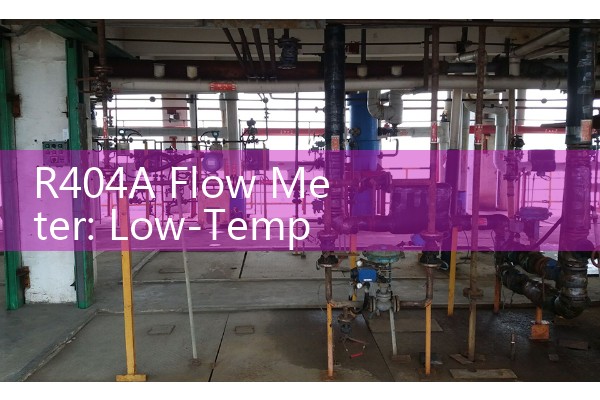
Last year a seafood export company in Da Nang, Vietnam, needed a flow meter for their R404A blast freezer tunnel. Their process runs at -38 °C evaporating temperature. They had tried a cheap paddle-wheel meter that gave readings drifting by 15% after the first week. The meter housing had micro-cracks from thermal shock. Silver Instruments supplied a Coriolis meter with factory low-temperature calibration at -40 °C. The unit was installed with a bypass line for easy verification. After 12 months of continuous operation, the mass flow accuracy stayed within ±0.5% with no drift. The plant team reported zero safety incidents related to frostbite because the insulation and remote display kept operators away from the cold pipe.
R404A Flow Meter FAQ
Can I calibrate a standard turbine flow meter for R404A?
We do not recommend it. Turbine meters depend on viscosity calibration. R404A viscosity changes greatly with temperature. Even with low-temperature calibration, bearing drag at -40 °C will worsen repeatability. A Coriolis meter solves this with no moving parts in the flow path.
What is the minimum temperature Silver Instruments can calibrate?
Our standard cryogenic bench works from -40 °C up to ambient. For some projects we have calibrated at -60 °C using a liquid nitrogen heat exchanger. Tell us your lowest working temperature and we will confirm the capability.
How do you prevent frostbite when operating the flow meter?
We insist on fully insulated pipe, remote electronics, and strict warm-up procedures before any line breaking. Our installation drawings show the correct insulation thickness and breather drain locations. Training your operators on cold burn hazards is as important as the meter calibration itself.
Does Silver Instruments offer ATEX or IECEx certification for R404A meters?
Yes. Our Coriolis meters can be supplied with ATEX Zone 2 or Zone 1 certification for gas and dust. For ammonia refrigeration plants in the Middle East, we often combine ATEX with low-temperature calibration. The sensor is certified for use in explosive atmospheres where a refrigerant leak may occur.
What is the typical lead time for a calibrated R404A flow meter?
A standard DN15 Coriolis meter with low-temperature calibration ships in 3 to 4 weeks. Larger sizes up to DN25 may need 5 weeks. Expedited service is available. Email [email protected] with your project timeline for a firm delivery date.
Get a Quote for Your R404A Flow Meter
Tell us your working pressure in bar, the lowest fluid temperature in °C, the pipe size in DN, and the required flow range in kg/h. We will propose a Coriolis or thermal mass flow meter with the appropriate low-temperature calibration and ex-proof certification if you need ATEX Zone 1 for ammonia hybrid plants. Send your parameters to [email protected] or contact us via WhatsApp at 86-135-12131526. You can also call our application engineers at +86-135-1213-1526.
Silver Instruments supplies calibrated R404A flow meters to cold storage builders in Thailand, Philippines, Indonesia, and across the Middle East. Our Coriolis meters are tested at real low temperatures, not derived from ambient coefficients. See our Coriolis mass flow meter for refrigeration page for more technical data.